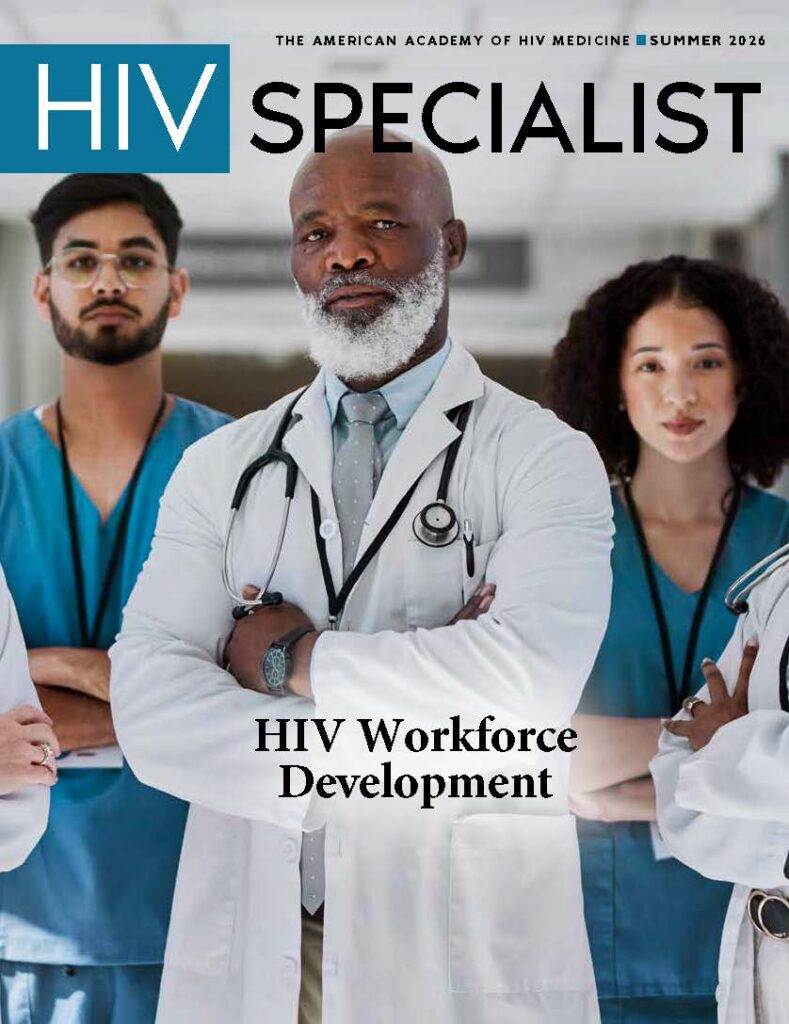
I’d like to welcome you to the first fully digital issue of the quarterly HIV Specialist. This all-new digital format replaces both the previous print and digital-flipbook versions and reliably goes with the reader wherever she goes: on the phone between patients in the clinic, on the tablet on trains and planes, on laptops later in the evening and so on. The format is new but will give readers a chance to access the same articles, information, and other content that readers of the HIV Specialist will have come to value in a more available and shareable format. As it has been, most of the content will continue to be written largely by Academy members and credentialees who are actively practicing the medicine and clinical management tools they’re describing. We expect this new digital magazine will open up a wider readership of the important and timely information contained in the HIV Specialist.
It’s also the same larger question facing the HIV workforce in the U.S. generally: How can we reach further? How can we reach further into underserved and disenfranchised communities, into care deserts, into migrant and undocumented populations, into the places that most need our attention, with the tools we have at our disposal? HIV care and prevention have never been the sole provenance of a single clinical discipline or profession, and we well know by now that every member of the care team holds an indispensable role in the HIV ‘status-neutral’ model of care and prevention delivery. New challenges are being confronted in the field as more people with HIV in the U.S. age further into the unique clinical complications of geriatrics, while those clinicians who have aged with them retire, complexifying the clinical field immeasurably. Growing, training, and sustaining the HIV workforce is the exigent condition for ending the HIV epidemic in this country and for expertly meeting existing patient need in these evolving environments.
In this issue, authors tackle those topics and delve into the interconnected parts of HIV clinician training and support and state and federal health care policies. In “Closing HIV Workforce Gaps Through Advanced Practice Providers and Pharmacist Integration,” By Vanesha Goffe, DNP, MSN-Ed, FNP-BC, AAHIVS, the author discusses how APPs and pharmacists are critical to an HIV team-based model of care and how scope-of-practice law may inhibit that model. Justin Hooks, DNP, FNP-BC, AAHIVS, HIV PCP, discusses how we can encourage a new generation of HIV providers in his article “Building the HIV Workforce Pipeline: Practical Strategies to Attract the Next Generation.” He highlights the challenges of recruiting new clinicians into HIV prevention and care, and offers practical strategies that we can begin implementing to attract and support new providers.
In her article – “Our Experience Developing the HIV Physician Workforce” – Elysia Engelage, MD, focuses on a specific HIV fellowship and shows how instrumental this training can be in welcoming new providers into the field. She discusses the impetus for the fellowship and how collaborations with community partners have been key to a well-rounded training program. Their fellowship ensures that internal medicine and family medicine physicians have training in HIV-specific care as well as in gender-affirming care, addiction medicine, HIV prevention, dermatology, sexual health and anal cancer screening.
Examining the HIV workforce would be incomplete without acknowledging the major influence that health care policy has on bringing in new clinicians and keeping those providers in the field. Both Elizabeth Sherman, PharmD, AAHIVP, and Christopher B. Fox, MSN, RN, ANP-BC, AAHIVS, discuss unique facets of the disruptions HIV providers can face when health policy is not aligned with the needs of HIV care. Dr. Sherman’s article, “Changes to Florida’s ADAP Are Impacting the HIV Workforce,” recaps the sudden, sweeping changes to Florida’s ADAP earlier this year and highlights how “disruptions like these exhaust established providers and discourage trainees from entering the HIV workforce.” Chris’s article – When HIV Funding and Workforce Falter, Patients Pay the Price” – discusses funding cuts that inhibit patient care and also talks about caps to student loan borrowers based on what is deemed a “profession.” He shows how these policies work together to inhibit growth in the clinical workforce overall and keep potential providers away from HIV care specifically.
Together, our commitment to a robust and thriving HIV workforce can guarantee thoughtful, creative, and enduring approaches, both training- and policy-based, that will support patient care now and into the future. I hope you enjoy the new reading experience and hope you’ll share your favorite articles widely on your social media networks. Let’s spread the message that excellent HIV prevention and care is only possible with an HIV workforce that is well supported through policy and education.