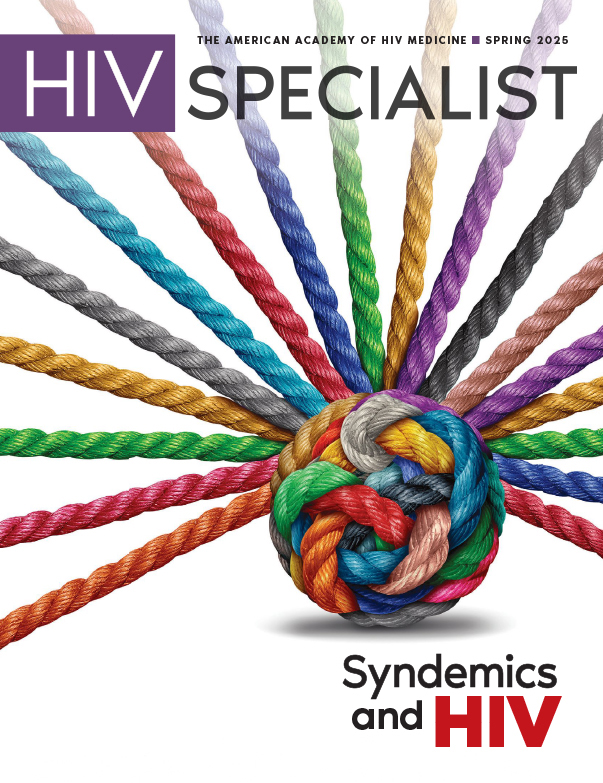
The spring issue of HIV Specialist is focused on the topic of syndemics and specific syndemic connections with HIV. “Syndemic” is generally defined as two or more health conditions that cluster and interact within a community because of social and structural factors. Syndemics are an important focus of addressing the HIV epidemic because HIV is one of the main health conditions that is affected by additional health issues and the exacerbation of social factors, including mental health and substance use syndemics. As the history of the HIV epidemic has taught us, in spaces and places and communities where there’s higher HIV incidence, there’s likely a lot of other factors that correlate with this, things that providers need to consider holistically to be able to optimize patient and community health.
In this issue, we set the stage with an overview of syndemics in “Syndemics and HIV: Unraveling the Complex Web of Health Inequities,” by Gary F. Spinner, DMSc, MPH, PA, AAHIVS. Gary provides a concise overview of the health conditions and social factors that work together to compromise the health of people with or at risk of HIV.
The article by Benjamin Kalayjian, MD, MAS, builds on Gary’s introduction by challenging providers to consider multiple facets of HIV care in their own practices. In “Syndemic Thinking and the Future of Health Care Design,” Dr. Kakayjian shows how his own practice, an FQHC, has worked to develop a synergistic coordinated support strategy to address social conditions that underpin the syndemic of HIV, other STIs, substance use, and mental health in their community.
Samara Jinks-Chang, MD, MS, MPH, and Renata Arrington-Sanders, MD, MPH, ScM, highlight how syndemics can also affect younger populations. In “The Syndemic of HIV and Substance Use in Adolescence,” they explain the unique risk factors in adolescents and young adults and discuss how to apply a youth lens to HIV and substance use syndemic care models. They outline up-to-date research on prevention, surveillance, treatment, and integrated care for adolescents and young adults.
In “The Impact of Methamphetamines on HIV Transmission and Care,” David Arteaga, MD, and Ellen Kitchell, MD, examine the complex relationship between HIV and methamphetamine use. They present a history of the methamphetamine and HIV syndemic and discuss the disproportionate impact of methamphetamine use on those with HIV. Finally, they offer practical insights on how clinicians can help people with HIV manage methamphetamine use disorder.
By David E. Koren, PharmD, MPH, BCIDP, AAHIVP, FIDSA, and Melissa Poulsen, PharmD, offer a pharmacist’s perspective to address the syndemic of HIV and mental health. In “Mental Health, HIV, and Managing Multiple Medications,” they outline important-to-know interactions between antiretroviral therapy and several classes of mental health medications, include antidepressants, antipsychotics, and benzodiazepines, among others.
Finally, Frankie Snow, LCSW, reminds us all that a multidisciplinary health care team that includes therapists and psychologists is an important part of tackling syndemics. Her article – “Addressing Mental Health and Substance Use in HIV Care” – provides examples of her interactions with patients navigating HIV and mental health or substance use difficulties and discusses the importance of providing mental health support in primary care setting. She also underscores the need for community action and policy change to respond to the needs of people with HIV who are also struggling with mental health or substance use disorders.
The At the Forefront section features an overview of the Dr. Dawn K. Smith HIV Prevention Clinical Fellowship and the work that has taken place in the first year of the fellowship. Angela Riley, PharmD, MPH, AAHIVE, Director of Community and Provider Engagement, describes how the fellowship honors Dr. Dawn K. Smith’s legacy and drives new recruitment in HIV prevention. Readers can learn more about each 2024-25 Fellow, their current work in HIV prevention, and their long-term goals.
We hope that this issue shines a bright light on the myriad factors that co-exist alongside HIV and HIV risk, and how providers can implement strategies to address all of the complicated co-morbidities and psychosocial factors that make HIV an exceptionally difficult phenomenon to confront.