Origins of HIV/AIDS Syndemic Theory
Syndemics arise when two or more clusters of epidemics occur within a population as a result of social and structural inequalities. First described by Merrill Singer in the 1990s, he hypothesized that harmful social conditions that contribute to disease concentration interact at the level of populations and individuals, with mutually reinforcing characteristics contributing to HIV risk.1 Singer first used the term “syndemic” to describe the concurrent epidemics of substance use (SU), AIDS, and violence (abbreviated SAVA). The individual burden of disease from SAVA was well-described; however, the synergistic effect when they occurred in tandem was more multiplicative than additive, a hallmark characteristic of a syndemic. “At the population level, the term syndemic refers to two or more epidemics interacting synergistically and contributing as a result to excess disease load in a population…At the individual level, the term syndemic refers to the health consequences of the biological interactions that occur when two or more diseases or health conditions are co-present in multiple individuals within a population.”2
The Synergism of Substance Use and HIV
Syndemic approaches have been utilized to reframe the concurrent epidemics of HIV alongside SU, violence, psychiatric illnesses, poverty, and housing insecurity.3 The HIV-SU syndemic remains one of the most well-characterized in the literature many decades since Singer’s initial characterization of HIV syndemic dynamics. There are multiple mechanisms by which SU predisposes individuals to HIV transmission and poor HIV virologic suppression, including: injection drug use (particularly with needle-sharing), transactional sex (including for money and/or drugs), behavioral disinhibition (unprotected sex), and suboptimal medication adherence (for pre-exposure prophylaxis [PrEP], antiretroviral therapy [ART] and other prescribed treatments).
Unique Vulnerabilities in Adolescents and Young Adults
Many of these risk factors are particularly salient for adolescents and young adults (AYA). Adolescence is a period of vulnerability when adolescents are navigating socio-emotional, cognitive, and developmental changes that may predispose them to risk.4 The exploration of SU and sexuality with simultaneous impulsive decision-making, limited frontal lobe maturation, and economic vulnerability can produce a syndemic effect that exposes AYAs to compounded risk.5 Most individuals with substance use disorders (SUDs) report onset of use in adolescence when experimentation with substances (and sexual exploration) are at an all-time high.6 Data from the Monitoring the Future Survey (MTF), an ongoing study of the behaviors, attitudes, and values of Americans from adolescence through adulthood, suggests that the most commonly misused substances during adolescence are alcohol and cannabis, both of which have been independently linked to increased condomless sex, engagement in exchange sex, and poor ART adherence. The most recent 2024 MTF results among U.S. 12th graders indicate past 12-month use of cannabis of 26.1 percent and past 12-month use of alcohol of 41.7 percent, with slightly higher lifetime cannabis and alcohol use (at 34.4% and 48.7%, respectively).7 Use of illicit drugs other than cannabis was reported at much lower rates in U.S. 12th graders, including a prevalence of 6.5 percent over the past 12 months and 7.8 percent in their lifetime. However, when specifically asked about prescription opioid misuse in the 2023 Youth Risk Behavior Survey, high school respondents reported a higher lifetime prevalence than seen in the MTF study (12%), with four percent reporting active prescription opioid misuse.8 Longitudinal data of high school participants who completed the MTF Survey in 1976 and 2013 at the age of 55, suggests that the prevalence of cannabis use peaks at age 18 and is the lowest in the late 40s, while prevalence of alcohol peaks at age 22 and is lowest in the early 40s.9
Just as experimentation with substances occurs during adolescence, so does sexual exploration. According to the 2023 Youth Risk Behavioral Surveillance System (YRBSS), 32 percent of U.S. high school students reported engaging in sexual activity and only 52 percent reported using condoms during their last sexual encounter.8 Chemsex, the practice of using psychoactive substances specifically to enhance sexual experiences (often in groups), is also well-characterized among some young men who have sex with men (MSM) and transgender women.10 Chemsex also refers to polysubstance use within peer networks of youth commonly with high rates of HIV and has been associated with impaired communication around condoms and higher rates of condomless anal sex in the context of stimulant use, particularly methamphetamines.11,12
Sexualized drug use (SDU) of alcohol and/or marijuana in all AYA is subject to similar network dynamics.12 These commonly available substances are known to reduce behavioral inhibition and anxiety, while simultaneously heightening confidence and sexual arousal.13 For youth with limited sexual experience, such feelings can be highly desired and prompt use both before and during sexual encounters, despite the adverse side effects of impaired cognitive functioning poor ability to plan and effectively communicate.13 The overall perceived benefits from substance use and sexual experimentation may be further heightened among the increasing number of adolescents with comorbid anxiety and depression seeking alternative low-barrier coping mechanisms in the absence of robust mental health supports.
HIV-SU Syndemic Effects in High-Risk Youth Cohorts
Among adolescents and emerging adults, substance-induced behavioral disinhibition further amplifies the neurobiologically mediated tendency towards impulsive behaviors and skewed risk assessments. The euphoric effects of SU along with increased sexual arousal further reinforce ongoing use. These factors ultimately result in heightened sexual risk-taking behaviors associated with HIV transmission, including increased partner number, condomless sex, and intercourse with anonymous sex partners.14 As a result, high rates of SU in AYA have been identified as a key factor in reduced prevention, treatment engagement, and adherence, ultimately contributing to disparities in HIV prevention and treatment among youth. One longitudinal cohort study of 450 young MSM aged 16 to 20 in Chicago found that the syndemic of SU, violence, and internalizing mental health comorbidities could predict cohort members’ number of condomless sex partners.15 Of the three syndemic factors studied, substance use, in the form of binge drinking, polydrug use and/or alcohol use disorder (per the DSM-IV), was the most significant predictor. Another study of young Black and Latino MSM and transgender women aged 15 to 24 at risk for or with HIV living in Baltimore, Philadelphia, Washington D.C., and Tampa/St. Petersburg demonstrated that polysubstance use was high with participants having a lifetime prevalence of alcohol (76%), cannabis (76%), ”other” illicit drug use (23%), and 86 percent reporting polysubstance use.16 Polysubstance use was associated with greater adjusted odds of pressure to have condomless anal sex, older partner (>5 years older), and inconsistent condom use.
A Youth Lens for HIV-SU Syndemic Care Models
To address the youth HIV-SU syndemic, innovative approaches are needed targeting every phase of the HIV care continuum. Effective syndemic approaches preferentially incorporate interventions for interconnected upstream factors to curtail their downstream impacts.3
Prevention in Primary Care Settings
For younger adolescents, the first interaction with the health care system to address high risk sexual behaviors and substance use at their onset generally occurs in the context of primary care. The Centers for Disease Control and Prevention (CDC) and American Academy of Pediatrics (AAP) recommend at least one routine HIV screening for adolescents ages 13 years and older, with at least annual screenings for those who are sexually active.17,18 For high-risk populations, more frequent screening is indicated every three to six months alongside risk counselling from their pediatrician. Despite the current guidelines, undiagnosed HIV remains most common among AYAs relative to other age groups. This is largely due to the fact that only seven percent of U.S. high school students in 2023 reported ever being tested for HIV.6 This represents a modest increase from six percent in 2022, but a substantial decline from the 13 percent of high school students who reported being tested in 2013.
Similarly, the AAP recommends use of a validated youth SU screening tool, such as Screening to Brief Intervention (S2Bi) or Brief Screener for Tobacco, Alcohol, and other Drugs (BSTAD) to first screen adolescents ages 12 to 17 for SU.19 This should be followed by risk stratification with assessment tools like the CRAFFT, a clinical questionnaire used to identify problems associated with substance use, in order to tailor counselling, treatment, and potential referral to treatment based on risk of higher severity. However, it is even less clear to what extent screening for SU in AYA is occurring nationally in the absence of universal laboratory tests and mandatory case reporting, as in the case of HIV.
From a prevention perspective, low screening rates for both HIV and SU in youth are a missed opportunity that fail to take advantage of the fact that their shared syndemics can result in mutually beneficial strategies and interventions. For example, the brief intervention strategies incorporated within the Screening, Brief Intervention, Referral to Treatment (SBIRT) model for SU are also transferable to counselling on sexual health, including requesting permission, assessing readiness to change, providing feedback and education on negative consequences that acknowledges short-term positive effects, and negotiating behavior change before arranging for appropriate level of follow-up care.19 Prior studies have additionally demonstrated high co-occurring SU and HIV in communities, suggesting that synergistic detection approaches are also needed.20,21
Surveillance and Early Detection
A syndemic approach that leverages surveillance tools – like syndemic mapping to identify hot spots of co-existing concurrent HIV and SU epidemics – is one such strategy. While these tools have been effectively used to identify HIV outbreaks in adults, current public health strategies have generally been limited in their ability to identify hotspots for youth SU and HIV due to poor real-time surveillance of youth SU and HIV patterns. With the exception of overdose tracking, which has been used to identify adulterated drug supply networks and hotspot counties for drug-related deaths specifically among adolescents, national youth SU datasets have not resulted in targeted interventions to address high incidence jurisdictions for youth SU in a manner similar to HIV.22 Even among areas with high AYA HIV burden, a recent study noted that the distribution of HIV testing sites was largely based on adult HIV burden, leaving populations between the ages of 13 to 24 vulnerable across multiple AYA testing deserts.23
Treatment Engagement and Adherence
In the absence of reliable universal surveillance to identify areas of both high HIV and SU burden among the most at-risk AYA age demographics, targeted interventions in communities with high HIV burden that inevitably experience the syndemic effects of high SU are being developed. These practical applications of syndemic theory generally involve integrated care models for secondary prevention to address treatment non-adherence, risk behaviors, and HIV and SU outcomes together. While there is no consensus on how best to integrate care platforms or who should deliver them, several models have been proposed primarily in adults, which would also have profound implications for AYA.
Sub-Specialty Clinic Integration
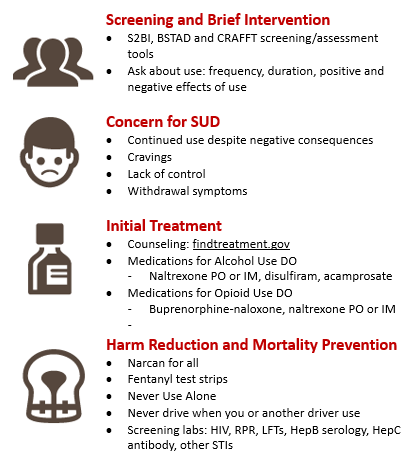
Co-locating SU and HIV services represents one of the most well-established integrated care approaches. Multiple studies have demonstrated that directly administering oral ART to patients with opioid use disorder (OUD) at methadone treatment centers reduces opioid use while improving ART adherence and viral suppression.24 A similar model for AYA could incorporate co-administration of injectable extended-release buprenorphine (FDA-approved for youth ages 16 and older) with injectable ART to treat high-risk youth with HIV and OUD or prevent HIV transmission altogether if injectable buprenorphine is administered alongside injectable PrEP. Additional medications for management of OUD and alcohol use disorder (AUD), as well as harm reduction strategies developed for adults, are gradually becoming more available at U.S. clinics targeting AYA (see Figure 1). While these models have been slow to gain traction in the U.S., the Canadian Foundry clinics across British Columbia represent an emerging large-scale network of integrated care centers designed to extend these types of SU services specifically to AYA ages 12 to 24 alongside mental health, physical health, and other social services.25
Figure 1. Approaches for treating AYA with SUD 28
Telemedicine and Mobile Clinic Interventions
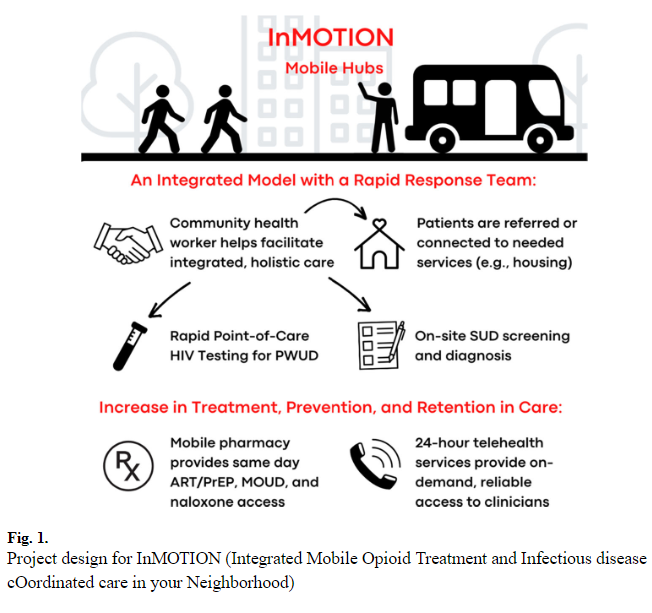
Delivering care directly to at-risk AYA populations, whether via mobile clinic or telemedicine, also overcomes patient level barriers (including transportation and low motivation), as well as system design failures (such as the AYA testing deserts that have not adapted to real-time care needs). For example, the Integrated Mobile Opioid Treatment and Infectious disease cOordinated care in your Neighborhood (InMOTION) mobile hubs offer rapid HIV testing, on-site SUD screening/diagnosis, and same-day ART/PrEP, medications for opioid use disorder (MOUD), and naloxone access.26 These services are made possible using 24-hour on-demand telehealth services to access clinicians and a team of community health workers coordinating medical care and referrals to additional services, including housing (see Figure 2).
Figure 2. InMOTION (Integrated Mobile Opioid Treatment and Infectious disease cOordinated care in your Neighborhood) Model 26
Mixed Models of Integrated AYA Care
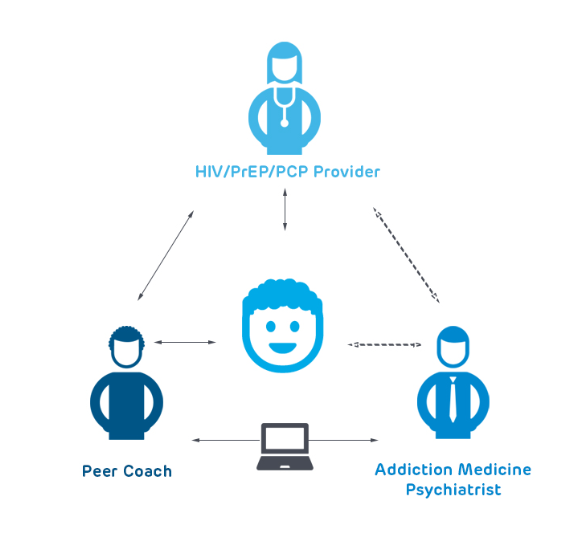
Additional models have incorporated a combination of both on-site and off-site telemedicine resources within an interdisciplinary team, such the as the Collaborative Care Prevention, Treatment, Navigation, Engagement, Resource (CC PrTNER) trial, which was designed specifically to target AYA.27 The ongoing one-year prospective study incorporates both peer coaching and addiction psychiatry consultation services to aid HIV/PrEP providers within a Collaborative Care model, with the goal of reducing viral load, increasing PrEP compliance, and reducing SU severity among their status neutral young Black and Latino men who have sex with men (YBLMSM) participants.
This approach draws from the original Collaborative Care (CC) model endorsed by the American Psychiatric Association, which has consistently improved outcomes for primary care patients with co-occurring mental health needs when PCPs have access to an interdisciplinary care team that includes a psychiatrist to provide caseload consultation as well as a care manager who coordinates with both the PCP and patient. PrTNER leverages the significant impact of peer coaches on youth with HIV as their care managers, alongside HIV/PrEP/PCP experts and addiction psychiatrists in the roles traditionally held by PCPs and psychiatrists within the CC model (see Figure 3).
Figure 3. CC PrTNER (Collaborative Care Prevention, Treatment, Navigation, Engagement, Resource) Model
Conclusion
The well-established impact of SU on increased sexual risk-taking behaviors is magnified in AYA, who are still developing the executive functioning skills necessary to make informed decisions, delay gratification, and forecast the long-term negative consequences of short-term poor judgment. The mutually reinforcing nature of the HIV-SU syndemic further increases levels of both SU and high-risk sexual behaviors in AYA. Even in the absence of real-time surveillance of HIV and SU hotspots among the AYA that are most at risk, syndemic frameworks are evolving to address the youth HIV-SU syndemic. These efforts require interdisciplinary teams comprised of primary care providers, subspecialists (with expertise in HIV/PrEP, mental health, and addiction), pharmacists, and community health workers/peer navigators. Integrated care models, including CC models, must build on synergistic treatment approaches that are adapted to the specific synergistic risk factors they seek to address within the syndemic framework. In addition, innovative care delivery models that include co-located services, telemedicine (for both patients and providers using consultative services), mobile clinics, or a combination of these approaches further accentuate the benefits of syndemic care. The ongoing design and implementation of innovative syndemic care models for AYAs has the potential to interrupt early HIV-SU syndemic dynamics with profound implications on both disease processes over the lifespan.