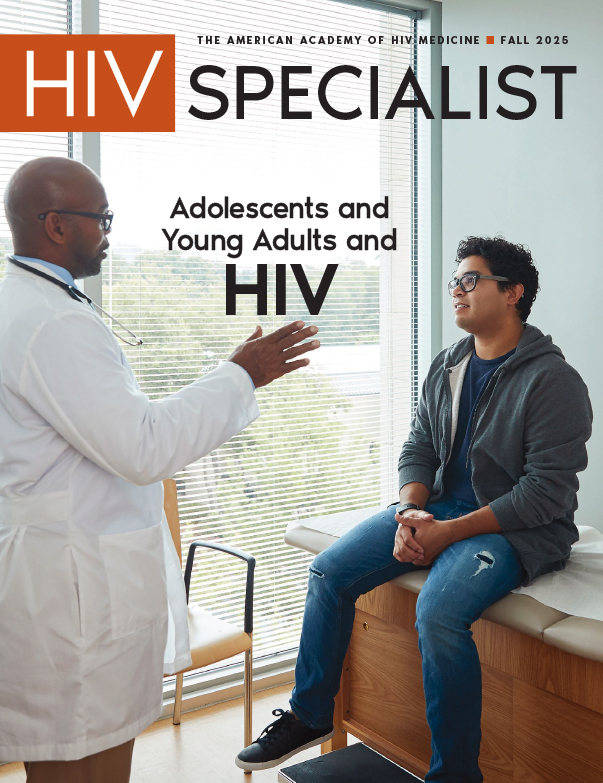
We tend to talk about HIV in big, tidy clinical categories: prevention, testing, care, treatment. Those frameworks matter but coldly flatten the people inside them. Living with HIV is not a single experience, and a clinical approach that assumes it is will always miss something important.
Adolescents and young adults (AYAs) sit right at that fault line. Their lives are shaped by transition, identity formation and evolution, instability, experimentation and constraint, often simultaneously. The clinical context is inseparable from questions of trust, autonomy, stigma, and timing. What works for older adults, or what looks good in a guideline, does not automatically translate here.
In this Fall issue, our contributors focus on how practitioners can better consider and tailor clinical approaches based on the specific needs of AYAs, not where our systems would prefer them to be. The feature article, “When ART Tips the Scale: Weight Gain Worries in Youth with HIV,” Dr. Timothy Howze and Dr. Susan Carr discuss the intersection of HIV treatment and possible weight gain side effects that can lead to distress in AYAs, who can be extremely sensitive to perceived negative body changes. The authors offer practical tips that clinicians can incorporate into their care of AYA patients with HIV.
Often, it’s important to support AYA with HIV through creative and novel approaches. Dr. Jeremy Snyder and Dr. Carly Cloud Floyd present how their practice established a multidisciplinary Young Adult Clinic to offer holistic, flexible, and developmentally sensitive care for AYA in their area. Their article “The Next Generation: Challenges and Triumphs of Young Adults with HIV” outlines some of the barriers to care that they attempt to overcome and highlights the success they’ve seen in their program.
Another fundamental piece of the AYA puzzle is ensuring adequate HIV prevention in this population. Dr. Diana Howard explores this in her article “Raising the Bar: HIV Risk and Prevention for Adolescents and Young Adults.” She talks about the biological, behavioral, social, and structural factors that can put AYAs at unique risk of HIV, and how clinicians can mitigate those risk factors. And, although HIV PrEP is approved for use in adolescents, the uptake in this population lags behind most others. In “Un-PrEPared: Barriers to Acceptance of Oral Pre-Exposure Prophylaxis for HIV Prevention in Adolescents and Young Adults,” Helen Urena and Dr. Joseph Cervia present original research on barriers to the use of PrEP in youth ages 13 to 24 years old. Their findings underscore the critical need for education and awareness of HIV PrEP for young people.
In discussions of prevention and treatment of HIV in AYA, we need to also keep in mind the mental health aspect of HIV care. Today it’s harder than ever to quickly get an appointment with a mental health professional, and this lack of access can be an incredibly difficult barrier for young people to overcome. Dr. Juan Pablo Zapata offers an interesting solution to help AYA engage with mental health care. His article “The Power of a Single Session: A Scalable Approach to Mental Health and HIV Care” explores a condensed format therapy session that offers brief, structured support in just one encounter. He gives an overview of this program, evidence-based results, and ways it can be adapted for digital use.
Finally, our CE-certified article, “Addressing Vasomotor Symptoms (Hot Flashes) in Menopause and Perimenopause: A Guide for Effective Team Management in Women with HIV,” by Sara E. Looby, PhD, ANP-BC, addresses the need for providers to understand the stages of menopause and how many of the symptoms associated with menopause can be similar to those associated with HIV. Dr. Looby discusses hot flashes in particular and why it’s important to adequately treat this menopausal symptom to improve quality of life for women with HIV.
This issue not only covers the ways providers can encourage HIV prevention in AYAs and support them in their treatment of HIV, but it also implicitly calls attention to the need for comprehensive sex education for young people. Although providers may not be able to fill in the gaps left from the dissolution of sex ed in many schools across the country, clinicians can approach sexual health care with openness and without judgment, providing a safe environment for young people to discuss their questions and concerns.