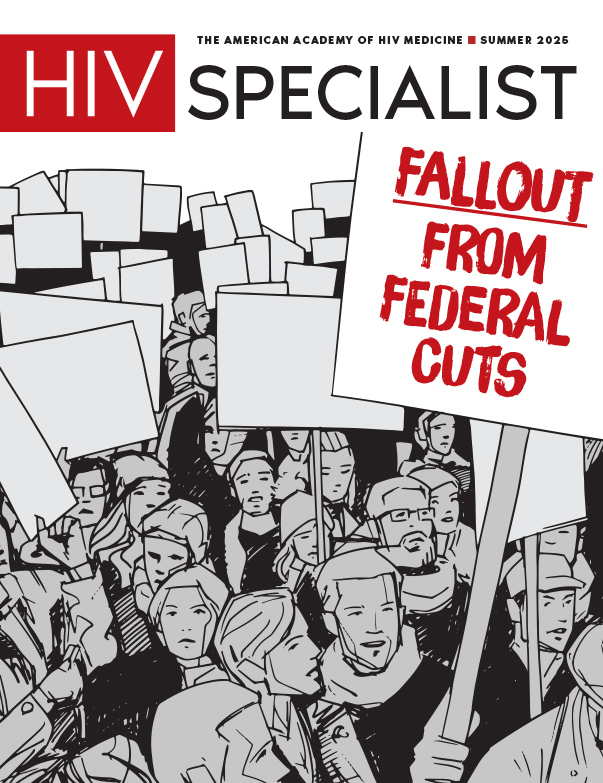
Fear, uncertainty, stress, and anger. Disruptions to care and research. Funding terminations. These are just some of the things many HIV and sexual health providers have had to navigate starting at the end of January with a flurry of executive orders (EOs) from President Donald Trump. Many of the EOs came rapidly, one after another, and were designed to undermine everything from diversity, equity, and inclusion (DEI) to “gender ideology extremism.” Caught in the middle of this storm are the patients and providers who are directly affected by these orders.
Added on top of that was the dismantling of the Federal workforce by the newly created Department of Government Efficiency (DOGE) and the halting of Congressionally approved grants that funded everything from public health departments to research critical for HIV care and advancements. The late winter and early spring of 2025 seemed like whirlwind of changes. Then, a proposed Health and Human Services budget was leaked that clearly showed the intent to decimate public health infrastructure as we know it and, along with it, the Federal HIV prevention scaffolding that has been instrumental in the efforts to end the HIV epidemic. Unfortunately, that budget became a reality and the entire public health and health care community will be faced with new and unplanned challenges in the years ahead.
Although these disruptions can shake the ground underneath us, the Academy is continuing its work to support HIV providers and those they serve. To support our members and give them a space to share thoughts, ideas, and plans of action with each other, the Academy’s membership and public policy departments hosted an advocacy town hall meeting on April 21. This article summarizes some of the comments and exchanges during that meeting.
Problems and Challenges
The hosts, Chauncey McGlathery, director of public policy, and Aaron Austin, director of membership, first asked participants if they had encountered any problems or challenges related to recent changes in federal and state policy this year. Here are some anecdotes from participants:
Participant 1
“So, I work at a federally qualified community health center in Richmond, Virginia, that also has a designation as a provider of health care for the homeless and also receives Ryan White funds from the Commonwealth. So, we’re getting hit from multiple different angles. One of the things that one of our outreach workers who works with our unhoused patients brought to the table as we think about how to galvanize efforts towards affecting change was to come up with the stories of the people that we take care of. And how do we present those in a manner that can be truly effective and impactful? So, we all know that we’ve been impacted in terms of Virginia hasn’t received its full Ryan White Part B grant. As a grantee, that impacts the services that we provide to patients. But what are the ground level impacts on day-to-day people that we can share with policymakers?”
Participant 2
“I agree that personal stories are the most powerful. But I do know that based upon my discussions with patients, there’s a lot of fear right now that people are going to have their medications taken away or their rights taken away, or they’re going to be deported. And so it just seems it’s a challenge in my mind about how to encourage people to share their stories when I think all of us are feeling a little hesitant to be forthright right now because we’re worried of what might happen.”
Participant 3
“How can we center the stories of patients when everyone is so fearful right now about retribution (especially LGBTQI, POC, and undocumented folks)? Patients are afraid.”
Participant 4
“I’m incredibly disappointed in the overall response by corporations and organizations in caving to the administration and rolling back DEI, etc. I’m part of a large academic medical center in a red state and still the vibe we are getting is that “we still support you and DEI but don’t raise a fuss and stay out of the spotlight.” But why? Why shouldn’t we stand up for our patients and our own basic rights? I have strongly encouraged all my colleagues who are in similar institutions to make sure to attend organization town halls and to make sure our organization leaders know we are still here. We just took the Gallup poll for team member engagement and I made sure to let leaders know we are still here and we are not well.”
Participant 5
“We do use resources from our CBOs [community-based organizations], like housing for example. That will be the other main concern that we have. Their resources have already been on hold since February. Our patients experience homelessness as well and they have nowhere else to go for any type of assistance, living or rental systems, or temporary housing.”
Participant 6
“Yeah, there’s a lot of personal anger. I think most faculty… I work at Hopkins, where a lot of my friends lost USAID funding because of work that they were doing in Africa related to HIV prevention. There’s a lot of terrible anger right now.”
Participant 7
“It is a burden, and we’re finding a little more fear every day here in Florida. Not only did we deal with DeSantis before we’ve dealt with the current federal administration, but we’re just struggling every day just to stay positive for our patients. For example, as of last week, we cannot see any transgender patient who uses Medicaid if they’re under 21. So a lot of us are very frightened. What are the threats? What are the complications and possibilities of all these things happening? And we really don’t know. So here we are with this large group now of 18 to 21 year olds who I can’t help. I can’t write their prescriptions. It is very hard on us. I saw patients early on in the AIDS epidemic from 1983 on. So, I’m not unaccustomed to having to defend a group–and not so much defend, but support and continue to ask that people be reasonable in thinking about what harm has a young transgender person done to you personally or to the government or anyone else. Why are we targeting this group?”
Participant 8
“I’ve been working in this area for a long time as well, like many of you, and remember back to even the Reagan and Bush days when fighting against the government was something that was really not unusual, and we did have to make sure that anything we sent to the NIH was carefully scrubbed of any particular words. This situation is even worse than that; then we were dealing with just negligence, being ignored. Here we are being attacked, and I think it’s even one step further in terms of aggressiveness.”
Ways to Address the Challenges
The town hall also included time to discuss ways providers and advocates can address the new challenges HIV care will face. Below are some thoughts and ideas that came from that discussion:
Participant 9
“I think that we, as HIV clinicians, really need to take an active and forceful and loud voice because the people that we take care of are vulnerable, they’re marginalized, and they’re really not people who, for lots of reasons, are going to have a voice of their own. But the fact is that we, as caregivers, need to really raise our voices, because if we don’t, then there’s no voice being spoken and nobody’s going to listen.”
“I know that people are probably fearful that if you’re in a community health center, you don’t want to march in front of your community health center and cause that attention. On the other hand, there’s lots that we can do as individuals, not necessarily representing our institutions. I think that we need to do that and we need to take a very active stance.”
“I’m a member of a group called Defending Public Health, and one of the goals of Defending Public Health is to have op-eds written in every state that details how public health funding is affecting those communities. And I think that for people working with patients, people in community health centers, you hear the stories, you see the stories, and I think it’s a great opportunity to write an op-ed. And op-eds are great, especially when you start out an op-ed with a story about a patient that you saw or a particular problem. I think it really can be very moving.”
“I also think white coat rallies and demonstrations can really be effective. It could be in front of a state capitol building. It could be in front of the U.S. capitol. But I think that it really promotes the image that health care providers are really concerned about what’s happening.”
Participant 10
“Op-eds are certainly a good outlet and many of us have done this for years – myself often around World AIDS Day. A big challenge these days is finding news outlets to publish them and get to the right audiences. We now only have one local newspaper for a community 600,000 people.”
Participant 11
“Having been to multiple white coat days in Sacramento, here in California, but also several in Washington, I don’t think there’s anything better than having health care providers go and speak to offices where legislators who are on the fence or who are in purple states can hear about how horrible things will be if they vote for a budget that is going to eliminate or decrease Ryan White or Medicaid or anything like that. We can write all the letters we want and we can sign on to all the letters we have, but actually having someone speak to a congressman or a senator’s staff is very, very helpful.”
Participant 12
“Advocacy for me is a little different because I’m working for the federal government. So, I’m trying to participate in meetings like this and help with recruiting people to attend the I think that may also help with advocacy because then people understand some of the changes that our patients and clients are dealing with. That’s what advocacy looks like for me. I wish I could do more, but I feel like my hands are tied. I am terrified for my patients because a lot of them are undocumented.”
Participant 13
“I guess I agree with all of this, and there’s a part of me that does wonder at the agency level, HHS and HRSA, if the academy is able to just share what conversations the Academy may have had with providers. I’m hyper-focused on Ryan White right now, and so I have to guess that the Office of Budget is going to ask people specific to that agency to make some of those decisions, or at least flag what they deem to be priorities.”
Participant 14
“Right now, local partnerships in Michigan are helping us. We had an uninsured patient who needed PEP and a group from Planned Parenthood and the YWCA were able to cover the medication. Reach out to groups in your local communities!”
Participant 15
“I use PrEP samples for undocumented folks.”
Participant 16
“A pharmaceutical company’s assistance program approved free PrEP for my uninsured undocumented patient without hesitation. That’s something to explore.”
At the Town Hall’s Close
The meeting wrapped up with a reminder that providers can share tips and stories via Academy Communities, the Academy’s message board. As well, to reach out to Chauncey or Aaron if they need resources or direction for getting involved in advocacy work. Finally, providers were reminded to take care of themselves in this moment. At the close, one participant recalled a quote from a poem that was read at CROI: “In a time of poor leadership, community is an act of resistance.” We are that community.
(Poem: “Inauguration 2025” by Loryn Brantz)