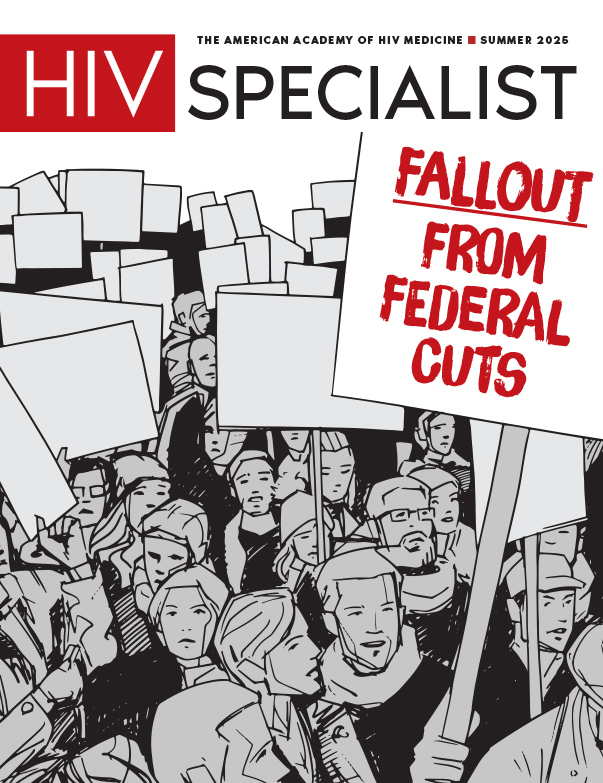
In the early months of this year, as the contours of the Trump Administration’s second term began to assert themselves with increasing clarity, those of us working in HIV care, research, and prevention found ourselves returning, sometimes reluctantly or wearily, to a question we had once hoped to retire: What becomes of communities most impacted by HIV and health inequities when national health policy veers sharply away from the idea that health care is a critical human right?
These changes together, in fits and bursts, have gradually altered the public health landscape, affecting the systems and structures through which HIV care and prevention is organized and delivered. What began as a stream of administrative adjustments has, over time, required providers to reassess long-held practices, respond to new constraints, and adapt to a landscape still very much in motion. For many, this moment has underscored the importance of a renewed commitment to patients whose needs remain urgent amid evolving and uncertain conditions.
This issue of HIV Specialist gives shape and voice to that landscape, drawing on the experiences of providers, patients, and advocates who are navigating the ongoing effects of federal restructuring and resource withdrawal. It serves not only as documentation but also as a call to solidarity and thoughtful action. There is indeed a positive countermovement in difficult times: new alliances and coalitions are being formed, ideological rebalancing is underway, and we know that no matter what happens, at the end we will have a stronger and more unified voice for those who speak up on behalf of vulnerable communities.
In the article “‘Community Is an Act of Resistance’: AAHIVM Advocacy Town Hall,” we present a reflection on a recent Academy-hosted gathering where members shared strategies, anxieties, and convictions. The conversations reveal not only the strain clinicians are under, but also the inventiveness and moral clarity with which many are responding.
Gary Spinner’s piece, “At a Crossroads: Why HIV Specialists Must Embrace Advocacy and Speak Out,” revisits the foundational role providers have played in HIV/AIDS activism since the epidemic’s earliest days. He argues that the current moment demands the same combination of courage, clarity, and collective effort, and offers pragmatic pathways for clinicians to engage in meaningful advocacy today.
In “Unraveling the Safety Net: How Federal Changes Are Stripping Away Hope for People with HIV,” Guerline Verger-Coreus and Elizabeth Sherman lay bare the consequences of recent federal policies for patients on the ground. “The fallout from these federal changes,” they write, “is not just a policy shift; it’s a human crisis unfolding in our clinics and in the hearts of our patients.”
Amy Maxmen’s article, “‘We Need To Keep Fighting’: HIV Activists Organize To Save Lives as Trump Guts Funding,” chronicles the determined work of community organizations and advocates striving to offset the damage wrought by funding cuts. Her reporting makes clear that the burden is increasingly falling on local actors, who are being forced to compensate for federal withdrawal with ingenuity and grit.
Finally, in “Donald, STOP! Trump Wages War Against HIV and DEI,” Brian J. Downs confronts head-on the administration’s deliberate dismantling of diversity, equity and inclusion (DEI) efforts, and its implications for HIV care. His essay offers a sharp critique, but also a reminder that these erosions are not merely symbolic, that they have real, measurable effects on the health and quality of life of our patients.
Taken together, the voices in this issue paint a picture of a profession under pressure, but far from paralyzed. In an era of radical retrenchment, it is our shared responsibility to stand firm, speak clearly, and act with compassion and resolve.